


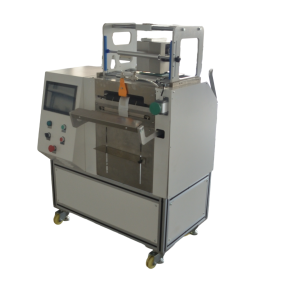
When it comes to automated packaging using pre-opened bags on a roll, legacy roll-fed bagging systems have long been recognized as industry pioneers. For years, traditional models have been the go-to choices for e-commerce fulfillment, hardware parts kitting, and medical device packaging.
However, as production environments in 2026 demand greater digital integration, faster changeover speeds, and higher cost efficiency, factory managers worldwide are facing significant bottlenecks with legacy systems. Exorbitant initial capital expenditures (CAPEX), prolonged lead times of up to six months, and being forced into high-priced proprietary film contracts have driven smart manufacturers to look for better alternatives.
Fortunately, modern packaging technology has evolved. Today, premium, industrial-grade roll-fed bagging machines with integrated TTO (Thermal Transfer Overprinter) systems offer identical—and in some aspects, superior—performance at a fraction of the cost.
Bevor wir uns mit den besten Alternativen befassen, wollen wir einen Blick auf die bahnbrechenden technologischen Veränderungen werfen, durch die moderne Alternativen herkömmliche Absackmaschinen in den Schatten stellen.
Die nächste Generation von „Print-and-Pack“: 3 bahnbrechende technologische Neuerungen
Eine wirklich zuverlässige Alternative sollte nicht nur kostengünstiger sein, sondern auch die alltäglichen betrieblichen Probleme lösen, mit denen Betreiber und Ingenieure in der Produktion konfrontiert sind. Unser Ingenieurteam hat diese Herausforderungen analysiert und drei bedeutende architektonische Durchbrüche erzielt.
1. Zentrale Steuerung: 10,1-Zoll-Industrie-Touchscreen mit Windows-Betriebssystem
Die Herausforderung der Branche: Standard legacy systems often force operators to manage two completely separate interfaces. You have one touchscreen to configure the bagging machine parameters (bag length, speed, indexing) and a separate handheld controller or terminal for the TTO printer. This fragmented workflow doubles formula setup times and increases the risk of human data entry errors.
Die Lösung der nächsten Generation: Modern high-end alternatives have broken down this hardware barrier. Both the motion control system of the bagging machinery and the TTO print template management are unified into a single, cohesive software architecture running on a 10.1-inch industrial Windows OS touchscreen.
Der geschäftliche Nutzen: One screen rules it all. Operators can adjust mechanical bag settings, input real-time batch data, pull up label layouts, and monitor production analytics from one centralized dashboard. This seamless integration drastically reduces employee onboarding and training times by up to 50%.
2. Hochgeschwindigkeits-Synchronisation: 3-Achsen-EtherCAT-Bus-Servoantriebssystem
Die Herausforderung der Branche: Viele Einsteiger- oder ältere Abfüllmodelle auf dem Markt sind nach wie vor stark auf Pneumatikzylinder oder kostengünstige Schrittmotoren angewiesen. Da diesen Komponenten eine Positionsrückmeldung in Echtzeit fehlt, führt der Betrieb bei hohen Geschwindigkeiten häufig zu unregelmäßiger Folienspannung, ungenauer Beutelindexierung, Mikroschlupf und häufigen mechanischen Blockaden – was zu kostspieligem Materialverlust und Produktionsstillständen führt.
Die Lösung der nächsten Generation: To achieve maximum precision, advanced alternatives feature a 3-axis high-performance EtherCAT bus servo motor network. This establishes a high-speed, fully closed-loop distributed motion control system.
Der geschäftliche Nutzen: By micro-coordinating film feeding, heavy-duty sealing, and precise perforated tearing at a millisecond level, this 3-axis bus architecture guarantees millimetric positioning accuracy. Even during peak output cycles, the machine maintains a smooth, ultra-quiet operation with zero film slippage, protecting your bottom line from material waste.
3. Absolute Zuverlässigkeit: 4-Zonen-Beheizung und 360°-Rotationsversiegelungstechnologie
Die Herausforderung der Branche: In high-volume, continuous production lines, heat accumulation (thermal saturation) on the sealing jaw is the ultimate enemy of uptime. With traditional static, horizontal sealing bars, residual heat continually builds up over hours of operation. Unable to dissipate quickly enough, this excess heat causes plastic bags to overheat, burn through, blister, or stick to the sealing element, forcing unexpected line shutdowns just to let the components cool.
Die Lösung der nächsten Generation: To conquer this thermal bottleneck, cutting-edge systems feature a proprietary 4-zone independent heating system combined with a 360° rotary sealing design, paired with a precision directional air-cooling system. Instead of relying on a single static point of contact, multiple managed heat sources alternate and transfer thermal energy dynamically throughout continuous rotational motion.
Der geschäftliche Nutzen: Continuous sealing without localized overheating. Whether you are packaging ultra-thin poly mailers or thick, heavy-duty composite barrier bags, this constant-temperature tech ensures that from the 1st bag to the