


A bagging machine for sensors and electronic components fits when parts are light, bag counts per SKU are small, and every bag needs a variable code. It is the wrong machine when one SKU runs for weeks and peak speed is your only bottleneck. The checklist below turns each requirement into a measurement, a sample or a trial, so two quotes can be compared on the same basis.
Why small sensors and electronic parts break standard bagging assumptions
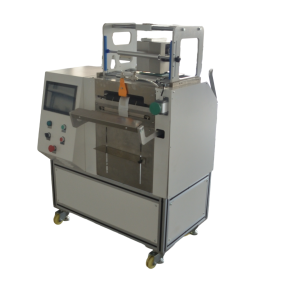
Small parts expose weak points in bag opening and sealing before they expose speed limits. A sensor body with a cable tail, or a reel of SMD components, needs the bag mouth to open wide and stay open during loading. Static also matters: a PE bag that clings to a plastic housing will not sit square under the sealing bar.
Print is the second differentiator. A sensor label usually carries a lot number, a 2D code and a date, not just a logo. On a JYZN-P350S pre-opened roll bag packaging machine, printing is built into the bagger, so variable data is produced on demand, one code per bag. That removes the separate label step and the label inventory that comes with it.
Sealing conditions need to be verified on your own film. Servo torque sealing with 360-degree wrap heating and air cooling is designed so thin film is not burnt through and thick film is not under-sealed. Set the seal window with a trial seal on your actual film and part, not from a spec sheet.
Speed carries a condition. The tabletop P350S runs 8–15 bags per minute; actual output depends on part shape, loading rhythm and whether an operator or a feeder loads the bag. In high-mix work, changeover and loading usually limit output, not the peak cycle rate. A bagging machine for sensors and electronic components is judged on that slower, loading-limited number.
Decision checklist: what to tick before you request a quote
Use the table as a working document. Each row is a question you can answer with a measurement, a sample or a trial, not an opinion.
| Item | What to record | Pass condition | How to verify |
|---|---|---|---|
| Part envelope | Longest, widest, thinnest dimension; weight; cable or tail present | Part enters the bag with clearance on all sides | Send a sample part and a bag drawing |
| Bag type | Single-side open roll bag; width, length, thickness | Film runs without skew at your load rhythm | Trial run on your film roll |
| Static behavior | Bag cling to housing, film curl | Bag opens square and stays open during loading | 10-cycle observation at the load station |
| 打印内容 | Characters per line; 2D code size; date and lot fields | Code fits the print area in one pass | Compare content against 53×55, 55×115 and 107×115 mm heads |
| Seal quality | Film thickness range, seal width | No burn-through on thin film; no channel on thick film | Trial seal, then peel and visual check |
| Changeover | Number of bag sizes and print recipes per week | Recipe recall from the touchscreen, no re-programming | Ask for a live recipe change during demo |
| Integration | Robot arm, weigh feeder, vibratory feeder, MES/ERP | Interface type confirmed in writing | Request the interface list in the quotation |
Two rows are commonly under-specified. Bag opening behavior with a cable tail needs a sample, not a photo. Print area must be matched to content: a 107×115 mm head covers larger label content in one pass, while smaller heads suit short codes. Pick the head from your content, then confirm it on a proof.
How to verify print, seal and bag opening on a demo
Ask for three checks and watch each one yourself.
- Print check: Print a live 2D code at production size on your film. Scan it with the scanner your line uses. Confirm the ribbon matches the printhead width and the film surface; a mismatched ribbon is the most common cause of patchy or non-scannable codes.
- Seal check: Run the thinnest and thickest film in your range. Peel the seal. If the thin film shows burn-through or the thick film pulls apart at the seal, the window is not set for your material.
- Bag opening check: Load ten parts in a row at the pace your operator will actually work. Count misloads or bag-mouth collapses. This is the number that decides whether the machine fits, not the peak rate.
The bagging sequence should be observable as one automatic flow: bag feed, pick and open, part loading, servo sealing, inline printing. If any step needs manual intervention at your typical part mix, that step will become the daily bottleneck.
For the coding side, compare heads on the thermal transfer overprinter page before the demo. Bring your worst-case label content: longest text, smallest 2D code, both date formats.
Cost and changeover: the numbers that decide payback
On small batches, changeover downtime usually costs more than peak speed. Evaluate changeover time, bag cost and consumable fit together. A recipe library that stores hundreds of recipes lets bag size and print content change from the touchscreen, so the economic question becomes how many SKUs you switch per shift, not how fast the machine cycles.
Consumables are part of the same equation. Single-side open roll film is pre-opened on one side and perforated on the other; width, length, thickness and print are customized to the pick mechanism and sealing parameters. A film that is not tuned to the pick mechanism will either fail to open or jam, and both outcomes erase the labor savings.
Build a simple payback sheet: bags per day, labor minutes saved per bag, film cost per bag, ribbon cost per code, and changeover minutes per switch. If changeover minutes per switch are high, the model with recipe recall pays back faster than the model with the higher peak speed.
Footprint is a cost line too. Casters let one operator move the machine between stations, and the unit can be interfaced with robot arms, weigh feeders, vibratory feeders and MES/ERP systems. Confirm the interface list in the quotation rather than assuming it.
FAQ
Can one bagging machine handle both sensors and reels of electronic components?
Usually yes, if the bag width and length cover both and the loading method is defined. The constraint is the bag opening and loading station, not the sealer. Test the awkward part first: a cable tail or a heavy reel.
Do I need a separate label printer for sensor labels?
Not if the bagger includes inline printing. Variable data is produced on demand, one code per bag, which removes the separate label step. Confirm print area against your label content before committing.
How do I check whether the seal is right for my film?
Run a trial seal on your own film at the thinnest and thickest gauge. Peel and inspect. Thin film must not be burnt through; thick film must not be under-sealed. Do not accept a seal verdict from a spec sheet.
What output should I expect on a tabletop bagger?
The P350S runs 8–15 bags per minute, with actual output depending on part shape, loading rhythm and whether an operator or a feeder loads the bag. Plan capacity from the slower loading case.
What should I send with a quote request?
Send a bag drawing and a sample part, plus your label content and ribbon type. That is enough to recommend a model and give a reference price band.
Send your bag drawing and a photo of the part — we will come back with a model recommendation and a reference price band within one business day. Contact us for a quote.
获取报价和机型推荐
请提供以下四项内容,这样我们就能一次性提供产品模型和参考价格区间,而无需花一周时间反复沟通:
- 背包尺寸(宽×长)或你今天使用的背包照片
- 零件尺寸、零件重量以及每袋装多少个
- 每分钟的袋装产量目标,以及每天的运行小时数
- 每袋是否都需要印上日期代码、批号或二维码
我们将在2个工作小时内回复,并在一个工作日内提供型号推荐及参考价格区间。如果您想先查看压印效果,请寄送一个样品零件,我们将为您制作一个试制袋。.