


Judge an automatic bagging machine for small parts by changeover time, film fit and a verified seal, not by the top speed on the datasheet. On high-mix lines, most output loss comes from changeover and loading rhythm. Run a trial bag, then a trial batch, then a production run, and sign off at each stage.
Wrong call 1: buying on peak bags per minute
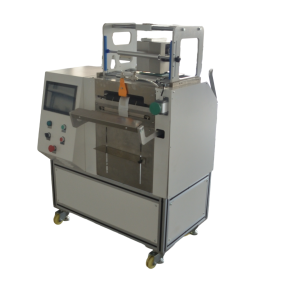
The tabletop JYZN-P350S runs 8–15 bags per minute. That range already carries its conditions: part shape, loading rhythm, and whether an operator or a feeder loads the bag. A quote that lists a single top figure without those conditions tells you little.
Small parts are the hard case. A 20 mm sensor or a loose fastener settles differently in the bag mouth each cycle. Pick-and-open timing, drop height and seal timing have to match the part, so the stable rate is usually below the peak cycle rate.
What to do instead: count the rate you actually need, then subtract changeover. If you run six SKUs a day and change over twice per shift, a minute saved per changeover can be worth more than two extra bags per minute. Ask the supplier to time a changeover in front of you, from touchscreen recipe recall to first good bag.
This is the trap with any automatic bagging machine for small parts: the number that sells the machine is not the number that runs your line. Measure the second one.
Wrong call 2: assuming any pre-opened roll film will run
Single-side open roll film is pre-opened on one side and perforated on the other. Width, length, thickness and print are customised to the pick mechanism and sealing parameters. Film that opens well on one machine can jam on another with a different pick geometry.
The seal target is consistency, not maximum temperature. Thin film must not be burnt through; thick film must not be under-sealed. Servo torque sealing with 360-degree wrap heating and air cooling helps hold that line, but the film still has to be matched to it.
Verify with a trial seal on your own film, not from a spec sheet. Send a roll of the film you intend to buy, plus a photo of the part, and ask for sealed samples back. Check peel strength by hand at both the seal edges and the perforation line.
| Check | Wrong approach | Correct approach |
|---|---|---|
| Speed | Quote one peak figure | Time bags per minute with your part and your loading method |
| Film | Buy film after the machine arrives | Trial seal your own film before signing |
| Changeover | Assume recipe recall is instant | Time recipe recall plus first good bag for two SKUs |
| Assume any ribbon fits | Match ribbon width to printhead and film surface | |
| Safety | Skip the obstruction test | Confirm overload protection with a supervised resistance test |
Wrong call 3: treating printing as a separate step
Printing is built into the bagger on JYZN machines, so variable data is produced on demand, one code per bag. That removes the separate labelling or label-printing step, but only if the print head, film and ribbon work together.
TTO print areas of 53×55 mm, 55×115 mm and 107×115 mm are available across the model range. They are optional configurations, not all fitted as standard. The 107×115 mm head covers larger label content in one pass. Pick the head against the largest code you will actually print, not the smallest.
Ribbon must match the printhead width and the film surface. A mismatched ribbon is the most common cause of patchy or non-scannable codes. Scan every code in the trial batch with the reader your customer uses, and log the failure rate.
The acceptance flow: trial bag, trial batch, production
Stage 1 — trial bag
Run one bag per SKU with the real part. Check that the bag opens fully, the part drops without catching the perforation, and the seal is flat with no wrinkles. Stop here if the bag mouth does not hold open.
Stage 2 — trial batch
Run 200–300 bags across at least two SKUs. Record bags per minute, reject count, seal appearance and code scan rate. Then change over to the second SKU using the recipe library and time it. Hundreds of recipes are stored and recalled from the touchscreen, so bag size and print content change without re-programming.
Stage 3 — production run
Run one full shift at your planned rate. Watch the dual-zone safety behaviour: the low-pressure zone prevents unexpected start-up and the torque-limited high-pressure zone gives overload protection if the seal meets abnormal resistance. Confirm with a deliberate obstruction test under supervision.
- Move the machine on its casters between stations and check the interface to your feeder or MES/ERP before sign-off.
- Log consumable consumption per 1,000 bags for both film and ribbon.
- Keep the first and last bag of the shift as seal references.
A staged acceptance is the only honest way to compare one automatic bagging machine for small parts against another. Same part, same film, same reader, two demonstrations.
Self-check list before you sign
- Does the quoted rate name the part, the loading method and the operator or feeder?
- Have you sealed your own film, at your own thickness, and tested peel by hand?
- Did you time a changeover from recipe recall to first good bag?
- Is the TTO head the largest one your codes need, and is it actually fitted?
- Does the ribbon match the printhead width and the film surface?
- Do all codes in the trial batch scan on your customer’s reader?
- Have you compared changeover time, bag cost and consumable fit together, not speed alone?
For the machine side, start from the JYZN-P350S pre-opened roll bag packaging machine and the thermal transfer overprinter (TTO) range, then confirm film and ribbon on the single-side open roll film page.
Send your bag drawing and a photo of the part. We will come back with a model recommendation and a reference price band within one business day. Contact us for a quote.
获取报价和机型推荐
请提供以下四项内容,这样我们就能一次性提供产品模型和参考价格区间,而无需花一周时间反复沟通:
- 背包尺寸(宽×长)或你今天使用的背包照片
- 零件尺寸、零件重量以及每袋装多少个
- 每分钟的袋装产量目标,以及每天的运行小时数
- 每袋是否都需要印上日期代码、批号或二维码
我们将在2个工作小时内回复,并在一个工作日内提供型号推荐及参考价格区间。如果您想先查看压印效果,请寄送一个样品零件,我们将为您制作一个试制袋。.