


A bagging machine for automotive parts works when five decisions are fixed before the quote: part geometry and pick method, loading rhythm, variable data content, bag opening side, and acceptance criteria. Get these wrong and no peak speed figure will save the project. Get them right and a tabletop unit can run a high-mix line for years.
Automotive parts are a hard fit. Sensors, clips, brackets, seals, and fasteners arrive in mixed shapes, mixed finishes, and mixed batch sizes. Most lines change over several times a week. The machine rarely limits output; changeover and manual loading do.
Decision 1: Part geometry and pick method
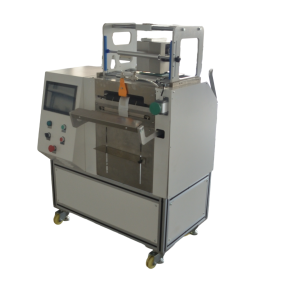
Start with the part, not the machine. Measure the longest dimension, the flattest face, and the drop height your part tolerates. A stamped bracket with a sharp edge loads differently from a rubber seal.
- Pick method: hand loading from a tray, vibratory feeder, or robot arm. Each changes cycle timing and the bag mouth width you need.
- Single-side open roll film: the film is pre-opened on one side and perforated on the other. A part that is thicker on one axis may need the opening oriented to that axis.
- Verification: load 30 parts by hand into an open bag. If the part catches the film edge more than twice, change the bag width or opening side before discussing speed.
Bring a película de empaque alimentada por rollo, abierta por un solo lado sample matched to your part when you book a trial. Film format and pick mechanism are designed together, not swapped later.
Decision 2: Loading rhythm versus quoted speed
The tabletop P350S runs 8-15 bags per minute. That figure holds only under stated conditions: actual output depends on part shape, loading rhythm, and whether an operator or a feeder loads the bag. Quote the condition with the number, every time.
Do the arithmetic on your own line. If one operator needs 5 seconds per part to pick, orient, and place it, the line ceiling is about 12 bags per minute no matter what the machine can cycle. A high-mix automotive line usually sits below peak cycle rate because of changeover and loading.
| Line condition | Typical limiting factor | What to verify in trial |
|---|---|---|
| Manual loading, small batch | Operator pick and orient time | Time 50 consecutive cycles with your operator |
| Vibratory or weigh feeder | Feed presentation and part jams | Run 30 minutes continuous, count stops |
| Robot arm interface | Handshake timing with seal | Check cycle sync on the servo bus |
| Multi-SKU batch under 500 pcs | Changeover between recipes | Time a full recipe recall and first good bag |
Acceptance should use the line figure, not the peak figure. Write the measured rate into the acceptance sheet.
Decision 3: What variable data goes on every bag
Automotive customers ask for lot codes, date codes, part numbers, or traceability strings. Decide the content and the print area before you buy.
The bagger carries the printer inline, so one code per bag is produced on demand. No pre-printed bags and no separate label step. TTO print areas of 53×55 mm, 55×115 mm, and 107×115 mm are available across the model range; the 107×115 mm head covers larger label content in one pass. Not all configurations are fitted as standard.
- List every field and its character count. A long traceability string needs the wider head.
- Check the ribbon width against the printhead. A mismatched ribbon is the most common cause of patchy or non-scannable codes.
- Verify: print 20 codes at production speed and scan each one with the scanner your customer uses.
Review impresora de transferencia térmica options before finalizing the bag layout, because print area and bag face size constrain each other.
Decision 4: Sealing consistency on your film
Seal quality is the most common complaint after installation. Thin film burns through; thick film under-seals and opens in transit. The servo torque sealing with 360-degree wrap heating and air cooling targets consistency, not a single temperature setting.
Test with your own film, not a spec sheet. Run a trial seal across the thickness range you actually buy. Peel each sample by hand and check for channeling or a partial weld. The dual-zone design gives a low-pressure zone against unexpected start-up and a torque-limited high-pressure zone for overload protection if the seal meets abnormal resistance. Confirm both zones respond during the site acceptance.
Decision 5: Changeover time and recipe library
On small batches, changeover downtime usually costs more than peak speed. A recipe library stores product recipes recalled from the touchscreen; the official figure is hundreds of recipes, so bag size and print content change without re-programming.
Judge it by action. Ask for a live changeover from one automotive part recipe to another during the trial. Time from last good bag of batch A to first good bag of batch B. Include bag roll change and ribbon change in that number.
Quote scope and acceptance steps
Quotes drift when film, ribbon, feeders, and interfaces are priced separately. Ask for a line-item quote that separates machine, film, ribbon, feeder, and integration. Treat robot arm, weigh feeder, vibratory feeder, and MES/ERP interfacing as optional adders unless your line needs them at start-up.
- Send part drawings and a photo of the actual part.
- Run a trial on your film and your ribbon, at your loading rhythm.
- Measure rate over 50 cycles and changeover over one full recipe swap.
- Scan 20 printed codes with your customer’s scanner.
- Seal-test across your film thickness range.
FAQ
Can one bagging machine for automotive parts handle both small clips and larger brackets?
Often yes, if the bag width range and print area cover both. Confirm by running both parts in one trial and timing the changeover between them.
Do I need the widest TTO head?
Only if your longest code string exceeds the smaller print areas. Count characters first, then choose between the 53×55 mm, 55×115 mm, and 107×115 mm options.
How do I know the real speed?
Measure 50 cycles with your operator and your parts. The 8-15 bags per minute figure for the P350S depends on part shape, loading rhythm, and loading method.
Where does the machine go on the line?
Casters let one operator move it between stations. Check floor space and the interface points for any feeder or robot before committing.
Send your bag drawing and a photo of the part to contact us for a quote. We will come back with a model recommendation and a reference price band within one business day.
Get a quote and a model recommendation
Send these four things and we can come back with a model and a reference price band in one go, instead of a week of back-and-forth:
- Bag size (width x length) or a photo of the pack you use today
- Part size, part weight, and how many pieces go into one bag
- Target output in bags per minute, and running hours per day
- Whether each bag needs a date code, batch number or QR code printed on it
We reply within 2 working hours and send a model recommendation with a reference price band within one business day. If you want to see the seal and print first, send a sample part and we will run a trial bag.